Do you know how long the slowest marathon in the world took?
And no matter how hard you try, there is no chance you can break this record!
We all remember the runners who broke major records. We remember Kipchoge and his sub-2, Kiptum, who was the first to go under 2:01, while Kejelcha and Sawe showed us that the dream of going under 2 hours is no longer just a dream.
However, the slowest marathon of all time was run by a man who is considered the father of the marathon in his country. So, how is that possible?
To tell this story, we have to go back to 1912, and to the Olympics, because that year the Olympic Games were held in Stockholm. At this point, the Olympic movement was still in its infancy, and these were only the 5th modern Olympic Games, while Pierre de Coubertin's idea of sport for all was slowly developing. This was also the first time Serbia participated in the Olympic marathon, represented by the famous Dragutin Tomašević.
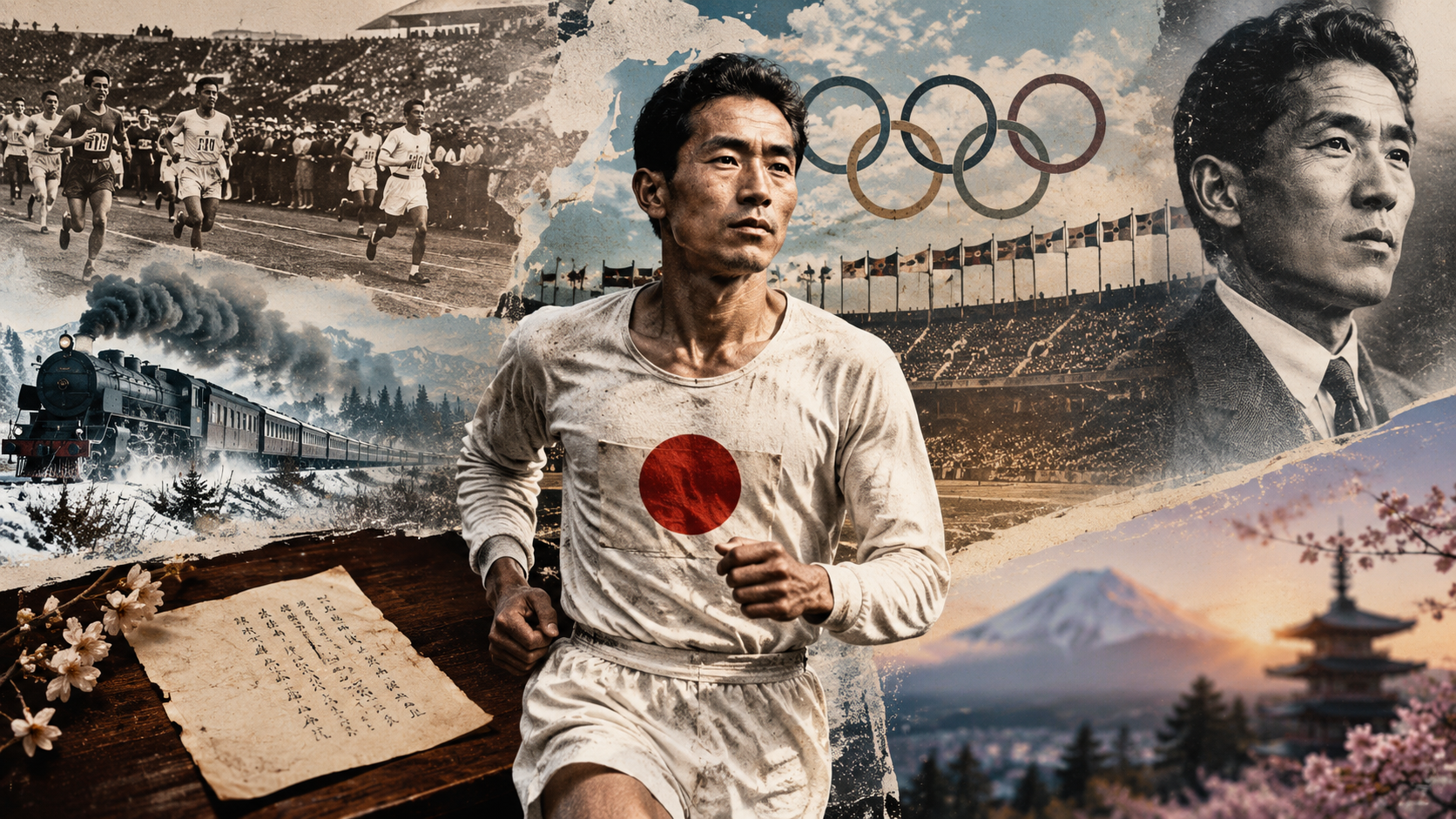
Now, on the other side of the world, in Japan, lived and worked our protagonist, Shizo Kanakuri. Shizo grew up in a rural environment, in a family that produced and sold sake, and because of the distance from school, he ran 6 km to school and back every day. Somewhere along the way, he fell in love with running and it became his passion, so in November 1911, he decided to enter the national marathon selection race, where he won and set a world record at the time! He ran the marathon in 2 hours and 30 minutes, without a single drop of fluid. At that time, and all the way into the 1950s, it was believed that drinking water during a race affected performance, and this is something that, like Chekhov's gun, will appear later in our story.
With a world record in his pocket, Shizo became one of two Japanese athletes who qualified for the Olympics. As we said, the Olympic movement was still in its infancy, and the level of organization we have today, with countries participating and Olympic villages being built, was not even present in the wildest dreams of the organizers of that time. As a result, Shizo had to raise money through a fundraising campaign to cover the cost of the long journey to Northern Europe. With the help of his classmates, he raised the necessary 1,800 yen, and it seemed that everything was ready for the world-record holder to step onto the biggest stage and bring glory to Japan.
But that's where the first problems began. In 1912, we didn't have intercontinental flights, and a flight in a small seaplane from Ireland to England was something the international press would have talked about for weeks. So Shizo had no choice but to travel by ship to Russia and then take the Trans-Siberian Railway on a journey by train that lasted over 15 days. Such a journey would not be easy even under modern conditions, and we can only imagine what it was like 114 years ago. That's where the first problems began: his coach was bedridden during the journey because of tuberculosis, his fellow athlete developed a fever, and Shizo couldn't handle the local food. During the journey, they were accompanied by the white nights typical of this part of the world, making sleep almost impossible. Shizo tried to train on railway platforms during stops along the way, but the entire journey, which took more than 3 weeks to reach Stockholm, clearly took its toll on the world record holder.
Sweden tried to organize the Olympics that year according to all the modern standards of the time. This was the first event where automatic timekeeping was introduced in athletics, so Stockholm is essentially where we get the first relatively accurate measurements on the track. But what the organizers could not predict was the weather and the fact that Sweden experienced the biggest heatwave it had seen in several decades that year. At the start of the marathon, there were 64 runners, and the thermometer showed 32°C. Dragutin Tomašević was there as well, but due to the inhumane conditions, he was unable to finish the race.
Now, remember the part where we talked about how runners at that time did not consume fluids? That belief, combined with the temperature, caused competitors to drop like flies, and this race also recorded the first death at the Olympics, when Francisco Lázaro died due to a lack of fluid intake, but also because of the clothing he was wearing. The long sleeves he wore did not allow him to sweat adequately, and unfortunately, that proved fatal.
Somewhere during the race, around the 27th kilometer, Shizo realized that he couldn't go on. Hypothermic and dehydrated, in the middle of rural Sweden, he came across a house where a family was having a celebration and, as an uninvited guest, entered and used gestures (because he spoke neither Swedish nor English, while the rural Swedes spoke no Japanese) to explain that he would like a glass of juice or water. He stayed there for some time, after which he thanked the hosts, left the yard, and no one ever saw him again. For years, the legend of the strange Japanese man was passed down from generation to generation, as was a scroll in Japanese that he had left them as a sign of gratitude for their hospitality.
Shizo did not cross the finish line, nor did he tell anyone that he had dropped out. The Japanese mentality and the shame he felt because he had failed to achieve his goal led him to secretly return to Japan on his own. Fearing that, alongside Lázaro, he might have been another victim of the inhumane conditions of the race, the Olympic Committee launched a search, involved the police, and Shizo ended up on Sweden's list of missing persons for the next 50 years.
Half a century passed, and a reporter from Swedish national television became interested in the story of the mysterious Japanese man who had disappeared at the Olympics 51 years earlier. He began an investigation and discovered that Shizo Kanakuri was still alive! He was living in Japan and teaching geography. Contact was established, and Swedish television offered the former world-record holder the opportunity to finish the race he had started half a century earlier.
Kanakuri gladly accepted the offer, boarded a plane, because he no longer had to travel by railway for 3 weeks, and on March 20, 1967, he finished his marathon, with an official time of 54 years, 8 months, 6 days, 5 hours and 32 minutes. After finishing, he said that it had been a long race. In the meantime, he had gotten married, had 6 children and 10 grandchildren.
When Shizo finished his race that had lasted more than half a century, he took the opportunity to visit the family who had given him juice that distant day in 1912. The son of the man who had hosted him welcomed him and, during their conversation, told him how the message in Japanese that he had left behind was being kept in the house as a family heirloom. Having completely forgotten about it, Kanakuri asked to see it and, embarrassed, admitted that the piece of paper was nothing more than an ordinary customs form in Japanese.
But the legacy of Shizo Kanakuri does not lie in the unbreakable record for the slowest marathon. In the years that followed Stockholm, Kanakuri proved to be a key figure in the development of the sport in Japan. He was instrumental in modernizing running shoes and, in that sense, a forefather of brands that dominate the world today, such as Asics and Mizuno. He was also the originator of Ekiden, a running format that is the most watched and most popular sport in Japan. All of this is why the Japanese consider him the "father of the marathon" of the Far East.