Gear

    Super Shoes: Do You Actually Need Them for Your Fall Marathon?

    By Alex, UESCA certified running coach | 18 Sept 2026 | 4 min read

    Super Shoes: Do You Actually Need Them for Your Fall Marathon?

    Sabastian Sawe ran 1:59:30 in London this year. Kenenisa Bekele is toeing the line in Berlin at 44. Chicago's elite field is stacked with sub-2:01 men. Every one of them will race in a carbon-plated super shoe, and every one of those shoes costs somewhere north of 300 euros.

    If you're training for your own marathon or half this fall, you've probably asked yourself the same question I get from almost every runner I coach: do I actually need a pair, or am I buying into the hype?

    Here's the honest answer, then the reasoning behind it. Super shoes help. The effect is real, and it's been measured directly in lab studies, not just felt by runners on race day. But how much they help depends heavily on who's wearing them and how they're used. For a lot of intermediate and advanced runners, the shoe turns out to be the smallest lever in the room.

    What the research actually shows

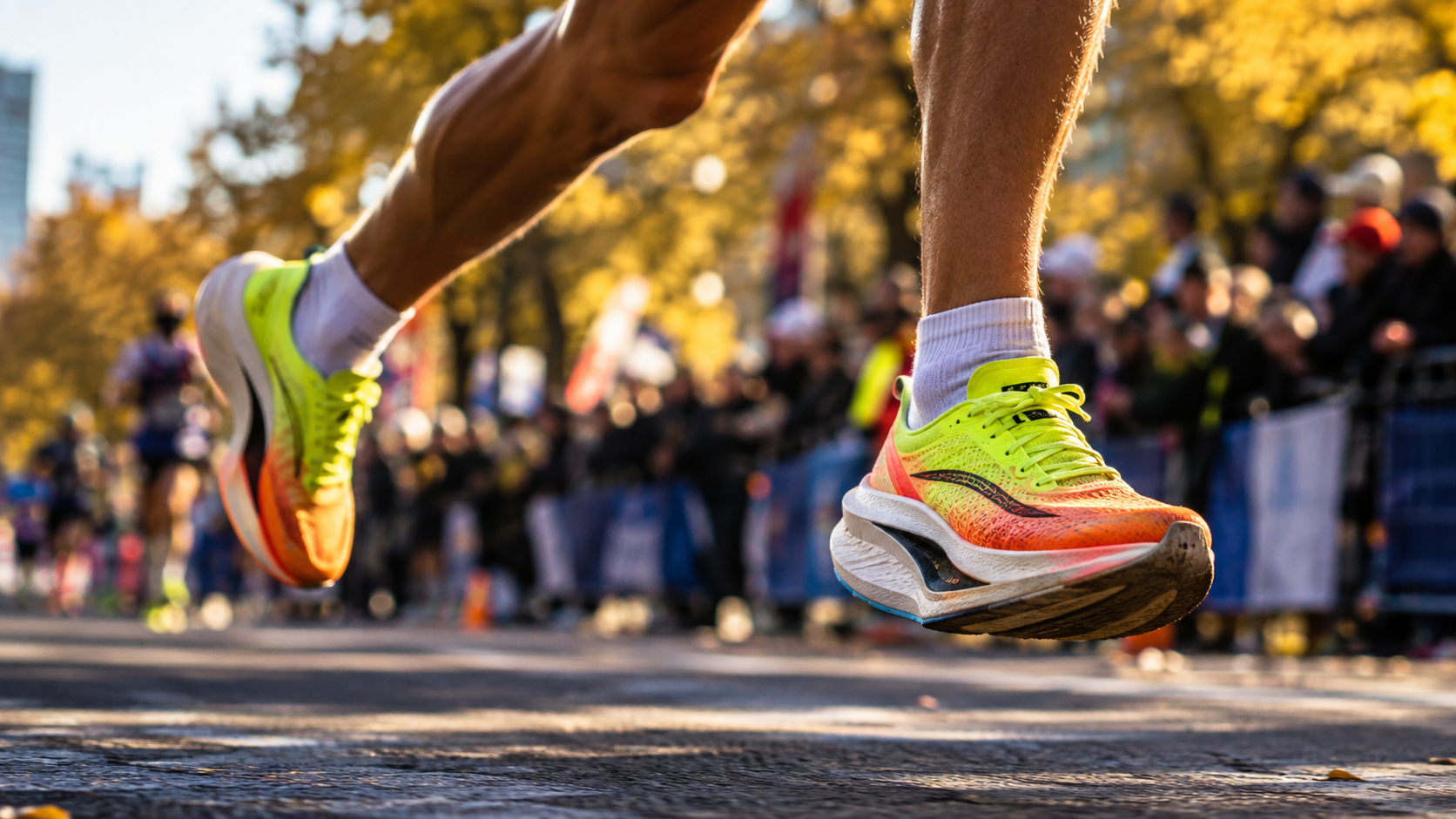
    The original studies on Nike's Vaporfly, and the wave of carbon-plate shoes that followed, found an average running economy improvement of around 4%. That's a real number. Translated into marathon time, it can mean several minutes for a runner already fit enough to hold pace for 26.2 miles.

    But "average" is doing a lot of work in that sentence. Follow-up research has shown the benefit varies widely between individuals, from close to zero for some runners up to 6-8% for others, depending on things like foot strike, running mechanics, and body weight. Heavier runners and runners with an already efficient natural stride tend to see less benefit than the averages suggest. There's no way to know exactly where you land on that curve without trying a pair over real training miles.

    The other thing the research is consistent on: the benefit shows up most clearly at goal marathon pace and faster. If most of your training and racing happens well below threshold, you won't feel much from the plate and foam. That's also part of why shoe brands are marketing so hard to recreational racers right now, even though the original testing was done at elite marathon pace. The further you are from that pace, the smaller the return.
    Why the pros wearing them isn't the whole story

    Watching Sawe or Bekele race in the latest super shoe tells you it works at the front of elite fields. It tells you almost nothing about what it'll do for a 3:45 marathoner or a 1:45 half marathoner, because the physiology at those paces is different.

    This is where I see runners get it backwards. They see the world record and the major-marathon coverage, buy the shoe, and expect a shortcut. Then they run the same training block they always have, wear the shoe on every run instead of saving it for the sessions and the race that call for it, and wonder why the improvement never shows up.

    A carbon-plated shoe doesn't replace the training that gets you race-ready. It sits on top of fitness you already have. If your aerobic base is solid and your threshold work has been consistent, a super shoe can be the last few percent on race day. If those things aren't in place yet, the shoe won't cover for it.

    Want a plan built around your goals?

    Free plans are a great start. For coaching that adapts to your life every week, this is what I do.

    See coaching options

    Who should actually buy a pair

    Here's how I'd think about it if you were coaching yourself through this decision.

    If you're racing a half marathon or marathon at a pace close to your current threshold, and you've got a structured training block behind you, a super shoe is a reasonable investment. Save it for race day and maybe your key long-run or tempo sessions in the final six weeks, so your legs and your gait get used to how the shoe behaves under fatigue. Racing in a shoe you've never trained in is asking for trouble.

    If you're newer to structured training, running mostly by feel, or your weekly volume is still building, spend the money on a proper training plan or a coach before you spend it on shoes. The fitness gap between an unstructured block and a periodized one is far bigger than 4%.

    Trail and ultra racing is a different conversation. There are trail-specific plated shoes now, but the terrain and pacing demands are different enough that most of the marathon-major research doesn't transfer cleanly.

    The bigger picture for this fall

    With Berlin and Chicago both happening this September and October, and a new round of shoe releases timed to each major, you're going to see a lot of noise about which shoe is "fastest." Most of that noise is marketing dressed up as data.

    What matters more is whether your training between now and race day earns you the chance to use whatever benefit the shoe offers. Build the fitness first, and let the shoe be the finishing touch rather than the plan.

    If you're putting together your own build for a fall race and want a second opinion on whether your training actually matches your goal pace, that's exactly the kind of thing I go through with the runners I coach every week. Reach out and we can look at where you're at.

    Alex, UESCA Certified Running Coach

    Alex, UESCA Certified Running Coach

    15 years running. Coaching runners from 5K to 100K ultramarathon.

    Work with Alex

    More from the blog

    The Slowest Marathon in the World

    The Slowest Marathon in the World

    The story of Shizo Kanakuri is one of the strangest in Olympic history. A Japanese world-record holder traveled for weeks by ship and train to reach the 1912 Stockholm Olympics, only to collapse during one of the hottest marathons ever run. He disappeared without officially withdrawing, returned to Japan, and remained on Sweden's missing-person list for decades. Then, 54 years later, he came back to finish the race.

    7 min read30 Sept 2026
    Read article